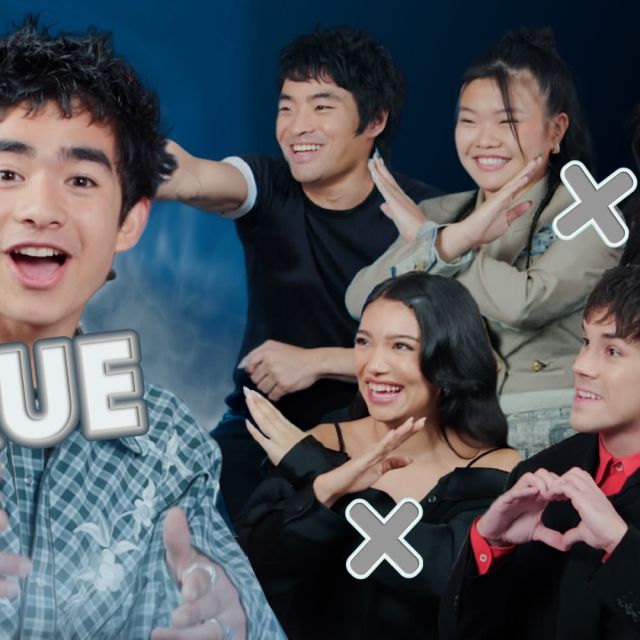
Rachel Sennott's new HBO series I Love LA is a bona fide discourse machine. Online, questions abound: Is I Love LA a normalization of Los Angeles gentrifiers, or a realistic portrayal of current LA vibes? Is it a complicated look at young social climbers, or an ideologically empty wannabe generational commentary? Is it a “nightmarish” version of shows like Girls or Insecure? Is it “spiritually AI”? Is it even funny at all?
Sennott seems to have known these questions would come. She especially knows you're comparing I Love LA to any number of predecessors — Girls, Insecure, Sex and the City — and even contemporaries like Overcompensating and Adults.
“Girls, Insecure, Sex in the City, those were all shows I love and really inform me just as a person and as an artist,” Rachel Sennott tells Teen Vogue, sitting beside her costar Odessa A'zion in their Halloween costumes (The Powerpuff Girls, with their costar True Whitaker rounding out the trio). “I think an influence that we talked about a lot was Entourage, or Internet ‘It' girls. We also talked about Atlanta as a big reference … I also want to say I think it's really cool and special to come out in a time where there's a lot of shows with young people like Overcompensating or Adults. I feel really lucky [that] so many of my friends, [like] Benny [Skinner] or Owen [Thiele], [are succeeding]. It's really cool to look around and see all these shows with young people and see a lot of friends.”

I Love LA centers on the fairly toxic, codependent friendship between talent manager Maia (Sennott) and influencer Tallulah (A'zion), and their chaotic friend group, completed by nepo baby LA native Alani (True Whitaker), celeb stylist Charlie (Jordan Firstman), and Maia's boyfriend Dylan (Josh Hutcherson), who is a teacher and the only person in their friend group who's not in “the industry.”
It lives in the rich tradition of media that show 20-somethings as self-absorbed, impulsive, and annoying — and because of these flaws, captivating to watch, even if you're rooting for some of them to fail and fall apart.
Sennott describes Maia and Tallulah as “two versions” of herself, split and blown up into new proportions. Tallulah is a bit of her New York self, “Messy and free and fun.” Maia is her LA transplant self, when Sennot was “feeling really out of control of my life and isolated and a little controlling.” These sides need each other to be a whole.

Sennott and A'zion are both aware of how it can feel like today's audiences are searching for some kind of moral purity or perfect decision-making when they watch television.
“I would rather have an interesting character that starts conversation than a character that's perfect,” Sennott says. A'zion agrees: “That's boring … I think that [the show is] funny and I think that everyone in it was really funny, and I hope that people can see it's just representing flawed people.”
Sennott, who is creator and executive producer, explains that the approach in the writers' room was one of “empathy and nuance,” and acknowledging the reality that no one is good all the time.
“Something I felt when I was younger was like everyone's either good or bad, good or bad. I was obsessed with being good and perfect,” Sennott says. “As I've gotten older, I'm like, it's all a spectrum, and every character has their good moments and their bad moments. I never wanted to show young people through this lens of they're so evil and vapid and bad and whatever, but they're comedy characters. Hopefully they're funny and they're flawed. Those are the most interesting characters that I like to watch … and to play. Even if they do things that people don't always agree with, hopefully they'll resonate with them.”

Sennott says the writers room took that same level of intentionality with the character Alani, who is the only Black woman in the main cast. (The show has also been criticized for the lack of Latino characters, at least in the episodes out now, considering Latino people make up nearly half of LA's population.)
“For all the characters, honestly, but specifically with Alani, we wanted to make sure we had a writer's room with different points of view and perspectives that spoke to our different characters, and we did have that,” Sennott says. “So experiences that I can't personally speak to were represented in our writer's room … that's why I think writers' rooms are so important."
“We had each actor come in and meet the writers and talk to them and just get a sense of their voice and their perspectives,” she continues. “The character of Alani is a nepo baby, and what we tried to do was sort of turn that trope on its head, because you think you maybe know what a nepo baby is like, but the reality is a lot of nepo babies that I know, they tell you a story and they're like, ‘It was so crazy,' and then they tell you a traumatic story and you're like, ‘Whoa.'” (Notably, True Whitaker is the daughter of Oscar-winning actor Forest Whitaker.)
.jpg)


It's these dualities that make up the character landscape in the series. The characters in I Love LA can be insufferable, like many of us, but they can also be supportive friends, or simultaneously oblivious and self-deprecating in a way that feels true to life.
A'zion points to this dynamic within Tallulah. “She really puts herself before others, even though I do think that she's a really loyal friend and really cares about her friends and her friends succeeding, but still, she [does] sh*t without realizing that it's going to hurt somebody,” A'zion says.
She recalls one moment in episode one where Tallulah comments on how cute and small Maia's apartment is, the same one they were supposed to share years back. “It's like, ‘B*tch, that is so rude.'”